The Three Gatekeeper Framework Every Executive Must Understand
By Matt Dupee, CPRW | Executive Career Strategist
You spent hours on your resume. You tailored it. You proofread it. You sent it out with confidence. And then nothing.
No callbacks. No interviews. Just silence.
This is the most common experience among senior executives in transition, and it is almost never about the quality of their work history. It is about a fundamental misunderstanding of how a resume actually gets read, by whom, and in what order.
After more than a decade of executive resume work and earning a TORI Award for Best Difficult Transition Resume, I developed a framework that has transformed the results my clients achieve. I call it the Three Gatekeeper Framework. Understanding it changes everything.
The Problem: You Are Writing for One Reader. There Are Three.
Most executives write a resume for a hiring manager. They lead with career narrative, highlight accomplishments, and communicate the depth of their expertise. That approach makes intuitive sense.
But a hiring manager rarely, if ever, sees your resume first. Before it reaches human eyes, it passes through two other gatekeepers, each with completely different criteria. If your document fails at any stage, the process ends. The hiring manager never sees it at all.
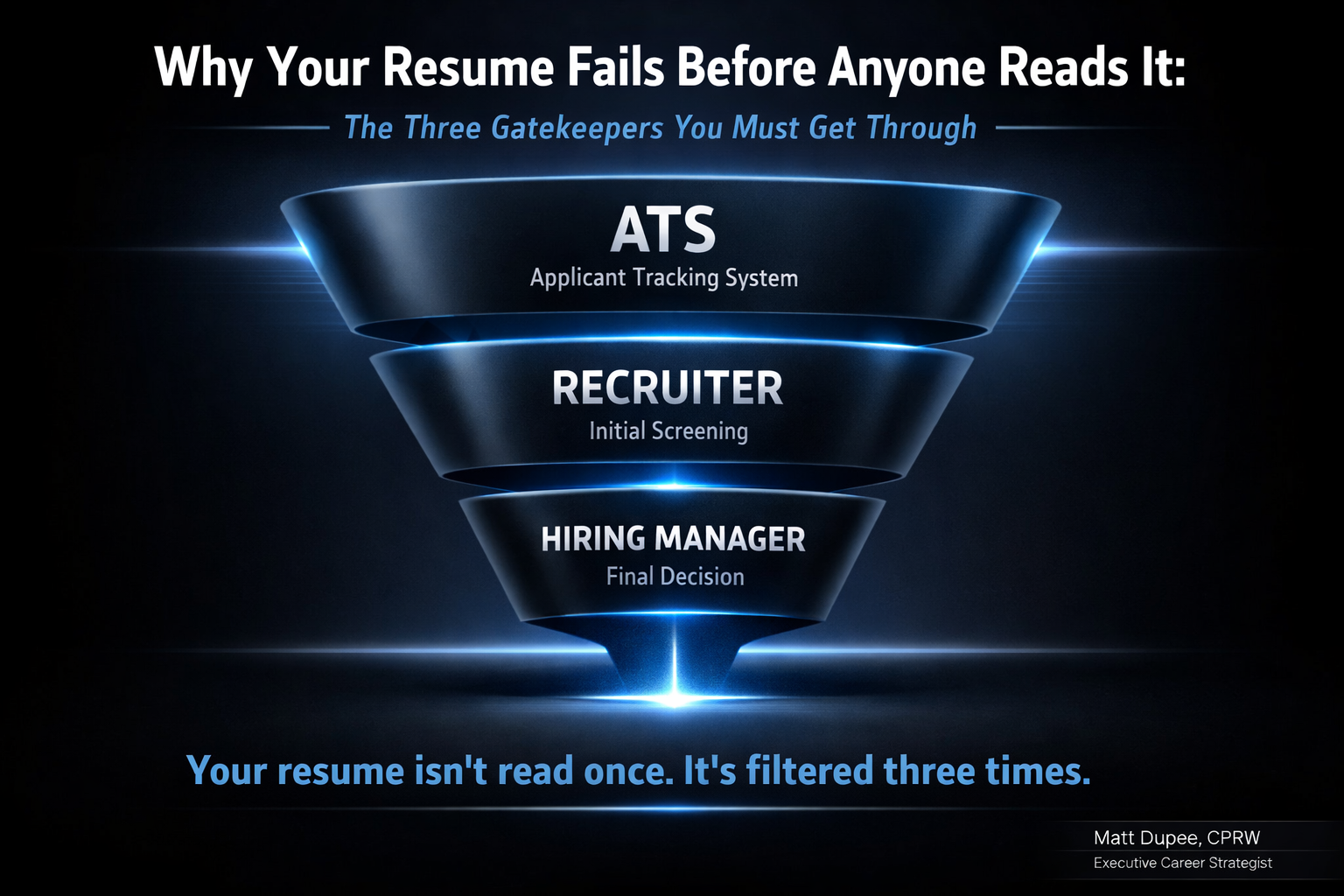
Your resume does not have one reader. It has three. And each one is evaluating something completely different.
The Three Gatekeepers are, in the order they encounter your resume:
- Gatekeeper 1: The ATS (Applicant Tracking System)
- Gatekeeper 2: The Recruiter or HR Screener
- Gatekeeper 3: The Hiring Manager or Executive Stakeholder
Each gatekeeper has a distinct purpose, a distinct lens, and a distinct set of criteria. A resume that wins with one and fails with another still loses. All three must be satisfied.
The Three Gatekeepers
| 01
THE ATS |
The Applicant Tracking System is software, not a person. It does not read your resume the way a human does. It parses text, extracts keywords, and scores your document against a predetermined criteria set before any human ever opens it.
Most enterprise-level companies and a large percentage of mid-sized organizations use ATS platforms. Your beautifully formatted PDF with its columns, text boxes, graphic elements, and embedded tables may look impressive. To the ATS, it is often unreadable noise.
What the ATS needs: clean, parseable formatting; relevant keywords aligned to the job description; standard section headers; and a text-based file structure it can process without errors.
What kills ATS performance: graphics, tables, headers and footers containing key information, unusual fonts, text boxes, and keyword misalignment. |
| 02
THE RECRUITER |
If your resume clears the ATS, a recruiter or HR screener is typically next. This is a human reader, but one operating under significant time pressure. Research consistently shows recruiters spend between six and ten seconds on initial resume review.
The recruiter is not reading. The recruiter is scanning. The question being answered is simple: Does this person broadly fit the profile we are looking for? If the answer is not immediately clear, the resume moves to the no pile.
What the recruiter needs: an immediately visible title or target role, a clear career progression, recognizable company names, quantified impact, and a clean visual hierarchy that makes the document easy to scan.
What kills recruiter performance: dense paragraphs, no visible metrics, buried titles, unclear value proposition, and a document that requires effort to interpret. |
| 03
THE HIRING MANAGER |
If the recruiter passes your resume forward, the hiring manager finally reads it. This is the reader most executives write for exclusively, and ironically, by this stage, the hard work of getting noticed is largely done.
The hiring manager reads more carefully, but is still evaluating fit through a specific lens. They want to understand not just what you did, but whether your experience translates to their specific context. They are asking: Can this person solve my problem?
What the hiring manager needs: demonstrated leadership impact, evidence of strategic thinking, accomplishments framed in terms of business outcomes, and clear relevance to their organizational priorities.
What kills hiring manager performance: a laundry list of duties with no outcomes, generic language that could describe anyone, and failure to connect your experience to their actual challenges. |
Why This Framework Changes How You Write
The Three Gatekeeper Framework has a critical implication: you cannot optimize for one gatekeeper at the expense of the others. Every strategic decision in resume writing involves trade-offs, and this framework gives you the structure to make those trade-offs intelligently.
ATS vs. Human Readability
Keyword density helps with the ATS but can make a document feel mechanical to a human reader. The solution is to integrate keywords naturally into accomplishment-driven language, not stack them in a keyword section that reads as keyword stuffing.
Visual Design vs. Parseability
A visually sophisticated resume impresses a hiring manager but can confuse an ATS. The solution is strategic design: clean, professional formatting that is visually organized but text-based and parse-friendly. No tables in headers, no text boxes, no graphic elements in key content areas.
Brevity vs. Depth
A recruiter benefits from concise, scannable content. A hiring manager may want more depth on relevant accomplishments. The solution is a layered approach: tight summaries and scannable bullet points for quick screening, with strategic elaboration on the most relevant achievements for the deeper reader.
The best executive resume is one that passes three completely different tests. That requires strategy, not just good writing.
The Areas of Emphasis Approach
One practical application of this framework is what I call Areas of Emphasis, a method for customizing resumes to specific opportunities without rewriting from scratch.
The concept is simple: within the body of a strong base resume, certain accomplishments and skills can be elevated or de-emphasized based on the specific role. This targets all three gatekeepers simultaneously.
- For the ATS: keyword alignment to the specific job description
- For the recruiter: the most relevant accomplishments surface at the top of each role
- For the hiring manager: the narrative connects your experience directly to their priorities
This approach is particularly powerful for executives targeting roles across multiple verticals or making a transition between industries, where surface-level experience may not immediately signal fit.
What to Do Right Now
If you are currently in a job search or preparing for one, here are three questions to evaluate your resume through the Three Gatekeeper lens:
- ATS Test: Copy and paste your resume into a plain text document. Does the content survive cleanly? Is it readable without the formatting? If not, the ATS may not be reading it correctly either.
- Recruiter Test: Set a timer for eight seconds. Look at your resume. What registers? Is your target role visible? Can you scan a measurable accomplishment immediately? If not, a recruiter cannot either.
- Hiring Manager Test: Read the job description of a target role. Now read your resume. Does it speak to their specific challenges and priorities? Or does it describe your past without connecting to their future?
The Bottom Line
Your executive resume is not a biography. It is not a job description. It is a strategic marketing document with three distinct audiences, appearing in a specific sequence, each evaluating you on different criteria.
The executives who understand this write differently. They do not just describe their careers. They engineer a document that passes each test in order, building momentum toward the conversation that matters most.
If your search is not producing the results you know you deserve, the problem is rarely your qualifications. It is usually your document’s ability to clear all three gatekeepers. That is a solvable problem.
You have done the hard work of building an exceptional career. Make sure your resume communicates that to everyone who needs to see it, in the right way, at the right moment.
About the Author
Matt Dupee is a Certified Professional Resume Writer (CPRW) and executive career strategist based in Vero Beach, FL. He is a 2020 TORI Award winner (First Place, Best Difficult Transition Resume) and has been recognized as a Top 12 LinkedIn Expert in Miami. His practice specializes in executive resume writing, LinkedIn optimization, and comprehensive concierge job search services for senior leaders across healthcare, financial services, technology, and professional services.